
Not every warehouse or industrial site is built with a permanent loading dock. Many facilities operate from open yards, rented warehouses, temporary storage areas, or project sites where civil modification is not possible immediately.
In such situations, loading and unloading from ground level becomes difficult, especially when forklifts need to enter trucks or containers. Manual handling takes more time, increases labour dependency, and may also increase the risk of material damage.
In such cases, mobile loading ramps become a practical option. They allow forklifts to move from ground level to truck or container height without constructing a permanent raised platform.
What Are Mobile Loading Ramps?
Mobile loading ramps are heavy-duty steel structures designed to bridge the height difference between the ground and the truck bed. They are used where fixed dock access is not available or where loading points need to remain flexible.
A typical mobile loading ramp includes:
- Reinforced steel deck
- Hydraulic height adjustment
- Front lip for truck or container connection
- Side guardrails
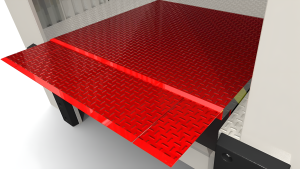
- Anti-slip grating surface
- Heavy-duty wheels
- Towing bar for relocation
- Safety chains
- Stabilizing support legs
The hydraulic system helps adjust the ramp height according to different truck bed levels. Once the ramp is positioned, secured, and supported properly, forklifts can move on the ramp for loading and unloading.
One major advantage is that mobile loading ramps do not require pit construction or major civil work. They can be shifted within the yard or moved to another site when the operation changes.
Where Are Mobile Loading Ramps Useful?
Mobile loading ramps are useful for facilities where loading access is required without permanent dock construction.
They are commonly used in:
- Warehouses without raised loading docks
- Open yard loading areas
- Logistics and distribution facilities
- Factories with ground-level loading points
- Temporary project sites
- Rented warehouses
- Facilities expanding their loading operations
- Sites where trucks and containers are loaded from different positions
For growing logistics and industrial operations in Saudi Arabia, this flexibility is important. A facility may start with limited infrastructure and later expand the operation. In such cases, a mobile loading ramp allows loading activity to continue without waiting for permanent civil construction.
How Mobile Loading Ramps Improve Operations
A mobile loading ramp helps create a controlled loading point wherever the site condition allows. Instead of depending only on manual labour or unsafe temporary arrangements, forklifts can move directly between the yard level and the truck or container.
This helps improve loading speed, reduces unnecessary handling, and keeps truck movement more organized. If the main loading dock is occupied or unavailable, the mobile ramp can also support additional loading activity.
The ramp is especially useful during peak operation, seasonal dispatch, warehouse shifting, or temporary project work where permanent dock construction may not be practical.
Important Points Before Selection
A mobile loading ramp may look simple, but wrong selection can create safety and maintenance issues. The ramp should be selected based on actual working conditions.
Load Capacity
The capacity should be calculated based on the combined weight of the forklift, operator, and the heaviest material being handled. Considering only the cargo weight is a common mistake. During operation, the ramp is exposed to moving load, braking force, repeated forklift movement, and impact.
Ramp Length and Slope
The ramp length affects the slope. If the ramp is too short for the required height, the incline becomes steep and forklift movement becomes difficult. A suitable ramp length helps the forklift move smoothly, especially when carrying heavy pallets or entering containers.
Truck Bed Height
Different trucks and containers may have different loading heights. The ramp should have enough height adjustment range to match the vehicles used at site. Before finalizing, the minimum and maximum truck bed height should be checked properly.
Ramp Width and Forklift Movement
The ramp width should match the forklift size, pallet movement, and loading pattern. There should be enough clearance for the operator to move safely, especially when handling heavy material.
Yard Surface Condition
The ramp should be used on a stable and reasonably level surface. Uneven, weak, or damaged yard surfaces can affect ramp stability and forklift movement. The site should be checked for surface strength, slope, drainage, and available turning space.
Safety Features
Side guardrails, safety chains, support legs, anti-slip surface, wheel locking arrangement, and proper front lip contact with the truck or container are important for safe operation.
Safe Use and Maintenance
Mobile loading ramps should be inspected regularly because they are used in outdoor yards and are exposed to forklift movement, dust, heat, and repeated loading cycles.
Regular inspection should include:
- Hydraulic system condition
- Deck and anti-slip surface
- Welded joints and frame structure
- Wheels and towing bar
- Safety chains and support legs
- Side guardrails
- Front lip condition
- General stability during operation
Operators should make sure the ramp is positioned correctly, secured to the vehicle, and supported properly before forklift movement starts. Overloading, poor positioning, and use on unsuitable ground can reduce safety and shorten the life of the ramp.
Why INNTESSA
The performance of a mobile loading ramp depends on correct selection, suitable capacity, strong fabrication, and proper after-sales support. A ramp may look simple, but if it is not suitable for the actual site condition, repeated operational and maintenance issues can start later.
INNTESSA supports customers with mobile loading ramp supply, site requirement checking, repair, maintenance, and after-sales service across Saudi Arabia. Our team can review the loading operation, vehicle type, forklift movement, site layout, and required capacity before suggesting the suitable ramp.